
Order and disorder in lists
Nicholas Zharkikh
Shortened text of the section. Full text in ukrainian version.
Researchers believe that if in the list of objects A, B, C, the unknown object B is placed between the known objects A and C, then this means that object B should be searched for in space between A and C.
This position has never been substantiated, but it is so widespread that it has become an axiom, the indisputable basis of all reasoning: how could it be otherwise?
Meanwhile, the above maps of indisputable objects show that it could have been different and actually was different. It is not possible to deduce from the order of objects in the lists no idea about the location of unknown objects.
Let’s take for analysis a well-filled list from the jarlyk of 1514. The approximately-optimal route I laid out looks like this:
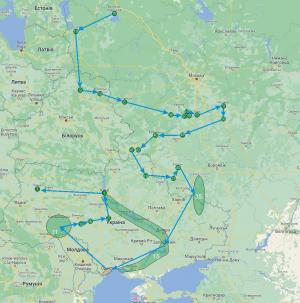
The optimal route of the 1514 jarlyk
Its total length is 4411 km. (I’d appreciate it if someone could come up with a more economical route.)
The route specified in the jarlyk looks like this:
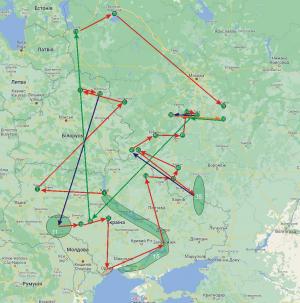
1514 jarlyk route (undisputed objects)
Its total length is 8435 km (almost twice as long) and the entropy, respectively, is 191%.
Now let’s add hypothetically localized objects to the route specified in the jarlyk:
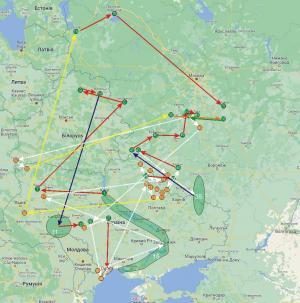
Route of the 1514 jarlyk
(indisputable and hypothetical objects)
Although I made the connecting lines to the hypothetical objects white / yellow dashed, the scheme looks very confusing, and this is a true impression. The total length of the route is 13,426 km, i.e. 304% of the minimum and 159% of the length specified in the jarlyk. Therefore, an attempt to enter hypothetical objects into the route significantly increases chaos (entropy) and refutes the usual, but not well-founded assumption that the list follows a geographical sequence.
I willingly believe that on a general map the scheme of bypassing Severshchyna cannot be analyzed, so I present it on a separate scheme on a larger scale:
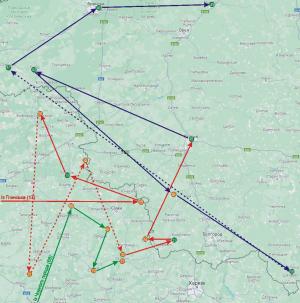
The route of the jarlyk of 1514 in Severshchyna
The diagram shows how the list returns to Severshchyna four times. How the researchers saw some kind of geographical arrangement here – I can’t guess.