
Chronology analysis
Nicholas Zharkikh
Shortened text of the section. Full text in ukrainian version.
Literary objects
Above, I repeated many times that purely literary objects that did not exist in reality are a real treasure for the researcher – a treasure that for some reason none of the researchers noticed and did not appropriate.
So, let’s collect all the data about such objects and see what they give us (11-line table).
Thus, the mention of Kleshchyn leads us to Veliky Novgorod of the 2nd quarter 15th century. (The Novgorod Karamzin’s Chronicle was not known anywhere outside of Novgorod). It seems to me that this is quite a lot.
Fortifications and temples
What do the few mentions of fortifications and religious objects give in terms of chronology? A table with 27 lines.
It can be seen that nothing is given specifically for the dating of mentions of fortifications – where the dates are known, they are not later than the 14th century, and there can be no doubt that in mid-15th century these fortifications existed in some form. The latest from early dates is given by the mention of a brick castle in Orsha (1432).
Of the 20 mentions of fortifications, 16 (80 %) are concentrated in three groups – "Lithuanian", "Novgorod" and "Pskov". Of these 16 fortifications, 13 are stone and three are mixed (stone + wooden). Apparently, from the point of view of the scribe of the SRG, the wooden fortifications, which had dozens (if not hundreds) of other towns mentioned by him, were considered outdated at that time, such that they did not deserve special mention.
Indeed, we have only two mentions of purely wooden fortifications in the SRG, which give the impression of random ones.
Mentions of the three St. Sophia churches also do not help with the chronology – they were all built in the middle of the 11th century and still exist. The mention of the Tithe Church is borrowed from the Hypatian Chronicle. Only St. Sophia of Polotsk is said to be of masonry; perhaps it was self-evident to the scribe that the mentioned churches were made of masonry.
Limiting dates for groups
Let’s now collect the extreme dates of the groups defined in the previous section in one table. Table for 21 lines.
Dates determined from ephemeral objects are highlighted in bold in the table. We see that the extremely late dates are of little use to us, because, 1, they are mostly based on ephemeral objects; 2, the historical memory of the destroyed object can last for tens of years, and for large cities – even hundreds of years. I think the scribe of the SRG used the data that were available to him, not worrying about their relevance at the time of writing the SRG.
It is a different matter with extremely early dates. Of interest here are the 1422nd year of Odoyev, the 1426th year of Vrev and two dates from the SGS (1432) – for Khotmyshl and Mezetsk. All these data strengthen the confidence that the SRG was compiled in the 2nd quarter 15th century.
Dynamics of the number of objects
Tonight I heard an air raid and then distant anti-aircraft artillery fire (not explosions). They write, that during this regular attach, the Muscovites attacked Kyiv with two dozen "Shaheds" (September 16, 2024 at 8:07 a.m.).
Dynamics is the development of something over time. Here we will consider the change over time in the number of objects mentioned in the SRG. In order to follow it, a technique is needed.
All mentions of dated objects can be divided into 4 types: newly established – the earliest mentions; lasting – mentions of the same objects in subsequent periods; disappeared – there were mentions in the previous period (periods), but there are no mentions in this period; restored – objects that were listed earlier, then disappeared, and now news about them appears again.
The following conclusions can be drawn from the table given in the previous section:
| Type | References until mid-13th century | Mentions of the 2nd half 13 – 3 quarter 14th century | Mentions 4 quarter 14 – 1 half 15th century | Mentions since the 2nd half 15th century and later ones |
| Newly established | 130 | 46 | 65 | 26 |
| Lasting | 57 | 92 | 172 | |
| Restored | 29 | 28 | ||
| Disappeared | 71 | 10 | 14 |
The data from the table can be presented more clearly in the form of the following diagram:
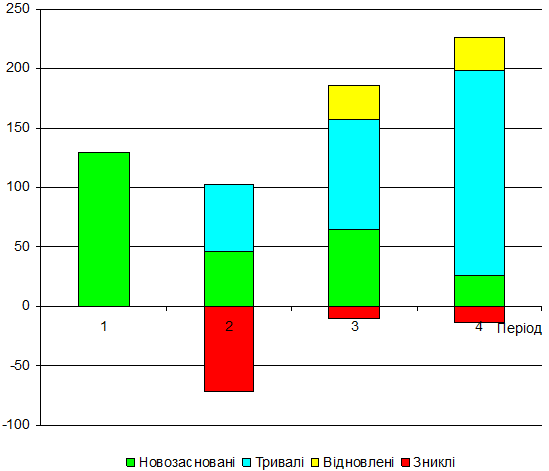
Distribution of SRG objects by periods of existence
What do we see from this table and diagram?
1, out of 264 dated objects of the SRG, we have 130 objects (50 %) with an Old Rus’ "birth certificate". They are the basis of the SRG and they are actually those "Rus’ towns", which the title of the list promises us.
2, of them, only 57 objects survived the Tatar ruin of 1237-1240 (they lasted in the 2nd period), and 71 objects disappeared in the 2nd period.
Of course, much more destroyed ancient Rus’ settlements can be counted in the annals, but we deal only with those listed in the SRG. It is also clear that the SRG scribe borrowed these missing objects from ancient written sources, i.e. chronicles (there are no other sources for ancient Rus’ times). Some of these destroyed settlements were restored in the 3rd and 4th periods, while those restored in the 4th period could not affect the SRG, the oldest copy of which was rewritten at the border of the 3rd and 4th periods.
3, the huge number of destroyed settlements shows the depth of obscuration (a term from Lev Gumilyov’s ethnological theory) into which Ancient Rus’ fell, shattered by the Tatar attack. The newly founded settlements of the Grand Duchy of Lithuania save the situation a little, but this "rescue" resembles "the average temperature of patients in the whole hospital." If such charts were to be constructed separately for the regions of Eastern Europe, at least within the borders of modern Ukraine, Lithuania + Belarus, Russia – the picture of obscuration would become much worse. But for this, historians have to work on history, and not just hunt for grants.
4, in the third and fourth periods, we do not see the systematic disappearance of settlements – the category of the disappeared includes mostly insignificant settlements that were not mentioned in written documents. It may be that some of these settlements continued to exist, but the rule of positivism requires us to find positive information about such existence.
5. In the third period, the number of long-lasting = long-lasting-2 + newly established-2 – disappeared-3. During this period, new settlements were actively founded on the territory of northeastern Rus’. A total of 186 out of 264 dated settlements, or 70 %, were mentioned in this period.
These data reveal two errors in the methodology that SRG researchers often fall into: first, it cannot be assumed that all the settlements mentioned in the SRG existed at the same time when the SRG was drawn up; secondly, by no means can it be assumed that all the settlements mentioned in the SRG existed in Old Rus’ times.
6. It is quite obvious that from the 10th to the middle of the 15th centuries there was never a single year when all the objects mentioned in the SRG existed simultaneously. Therefore, it is not possible to infer the date of compilation of the SRG from the facts of the simultaneous existence of certain objects.
7. In the 4th period, the total number of settlements continues to grow, which reflects the natural process of increasing population density and the subsequent establishment of new towns(as real scientists say – urbanization). But we are not talking about all the settlements of that time in general, but only about those mentioned in the SRG. And here there is a problem with the newly founded settlements – the first documentary mentions of them are later than the SRG. It appears that the SRG is the earliest written source that records the names of such settlements. I do not exclude the possibility that some settlements could exist long before their first mention – "invisible" for written sources. But every such case makes one wonder – how did the scribe of the SRG learn about the existence of such a settlement?