
14. "Bobruisk" group (No. 319 – 336)
Nicholas Zharkikh
Shortened text of the section. Full text in ukrainian version.
The "Bobruisk" group of objects in the SRG is formally included in the "A se Ryazanskiy" block, but its quality is very different for the worse even from the "Ryazan" group considered above. I named it after the first reliably localized object in its composition.
(319) Krylatesk
The only similar name is the village Krylatskoe, which was located on the banks of the Moskva River 11 km west of the Kremlin and since 1960 has been part of Moscow (Russia). Probability class – C.
(320) Nerynesk
It is assumed that this is a settlement near the village Kaledinovka in the Zaoksky district of the Tula region (Russia). Probability class – C.
(321) Kulatesk
Researchers think about hillfort 11 – 13 centuries near the village Koltovo Moscow region. Probability class – C.
(322) Roslal
For now, this object should be considered unknown. Probability class – D.
(323) Polskyi
This definition may refer to both the unknown Roslal and Swinesk (also unknown). It doesn’t help with localization. Probability class – D.
(324) Svinesk
This record is a duplicate of an unknown to science Svinesk No. 180. Probability class – G.
(325) Novgorodok on Osetr [river] (326)
Unknown object. Probability class – D.
(327) Bobruesk
The exact name is currently unknown, it has to be corrected Babruysk – a town in the Mogilev region of Belarus. Probability class – A.
(328) Dubechyn
The name Dubechyn is currently unknown, the most similar is the name of the village Dubechne in the Kovel district of the Volyn region. Probability class – C.
(329) on Plav[a] [river]
I accept with great effort the river Plava in the Tula region (Russia). Probability class – C.
(330) Mykytin
Unknown object. Probability class – D.
(331) Verderev
M. Tikhomirov pointed to the village Verderevo 9 km northeast of the town Skopyn, Ryazan region (Russia) [TMN2, p. 119]. This can be agreed with the caveat that the village has been known only since 1629. Probability class – B.
(332) Lomykhvost (= Breaktail)
Unknown object. Probability class – D.
(333) up the Don
The name of a large (1870 km) river Don no doubt. Probability class – A.
While I was engaged in science, Muscovites hit Kyiv with a rocket. The rocket was shot down, the debris hit a multi-story residential building in the Obolon district, six were injured (July 1, 2024 at 7:52).
(334) Dubok
Unknown object. Probability class – D.
(335) Kornike
It is assumed that it is hillfort near the village Gorodishche, Venyov district, Tula region (Russia). I can accept this localization only with great doubts. Probability class – C.
(336) Uryupesk
Unknown object. Probability class – D.
In terms of the number of objects, the "Bobruisk" group is almost equal to the "Ryazan" group – 18 objects. Of them reliably localized – 3 (17 %, and of these three, only Bobruisk can be a town, and the other two objects are rivers), localized with probable assumptions (B) – 1 (6 %), localized with complex assumptions – 6 (33 %), unknown – 7 (39 %), doubling – 1. The group is strongly dominated by unknown objects, the quality of the source of records is very low.
Map
In the "Bobruisk" group, we have only one reliably localized object – Bobruisk (327), so there is nowhere to lead the optimal route and it is not possible to calculate the entropy of the orderliness of the list.
Complete real route (classes A + B + C): 319 → 320 → 321 → 327 → 328 → 329 → 331 → 335 = 2335 km.
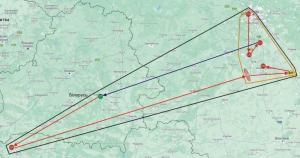
"Bobruysk" group.
Real route (classes A + B + C)
The polygon that covers all objects of the group is marked with a black contour on the map. Its diameter (328 – 331) is equal to 1057 km, that is, approximately equal to the diameter of the "Ryazan group".
With the removal of foreign objects – Bobruysk (327) and Dubechna (328), the core of the group (orange contour) acquires a diameter of 254 km (319 – 331), or 11 % of the total diameter. An eight-fold decrease in the diameter of the core of the group objectively shows that the "Bobruisk" group was formed formally, without understanding the real geography.
It is possible to combine the "Ryazan" and "Bobruisk" groups into one "super-Ryazan" group (300 – 336), which consists of three main subgroups with the insertion of two foreign subgroups (305 – 310, 327 – 328).